Credit Card on UPI in India (2026): RuPay Linking, Fees, Limits and Best Cards
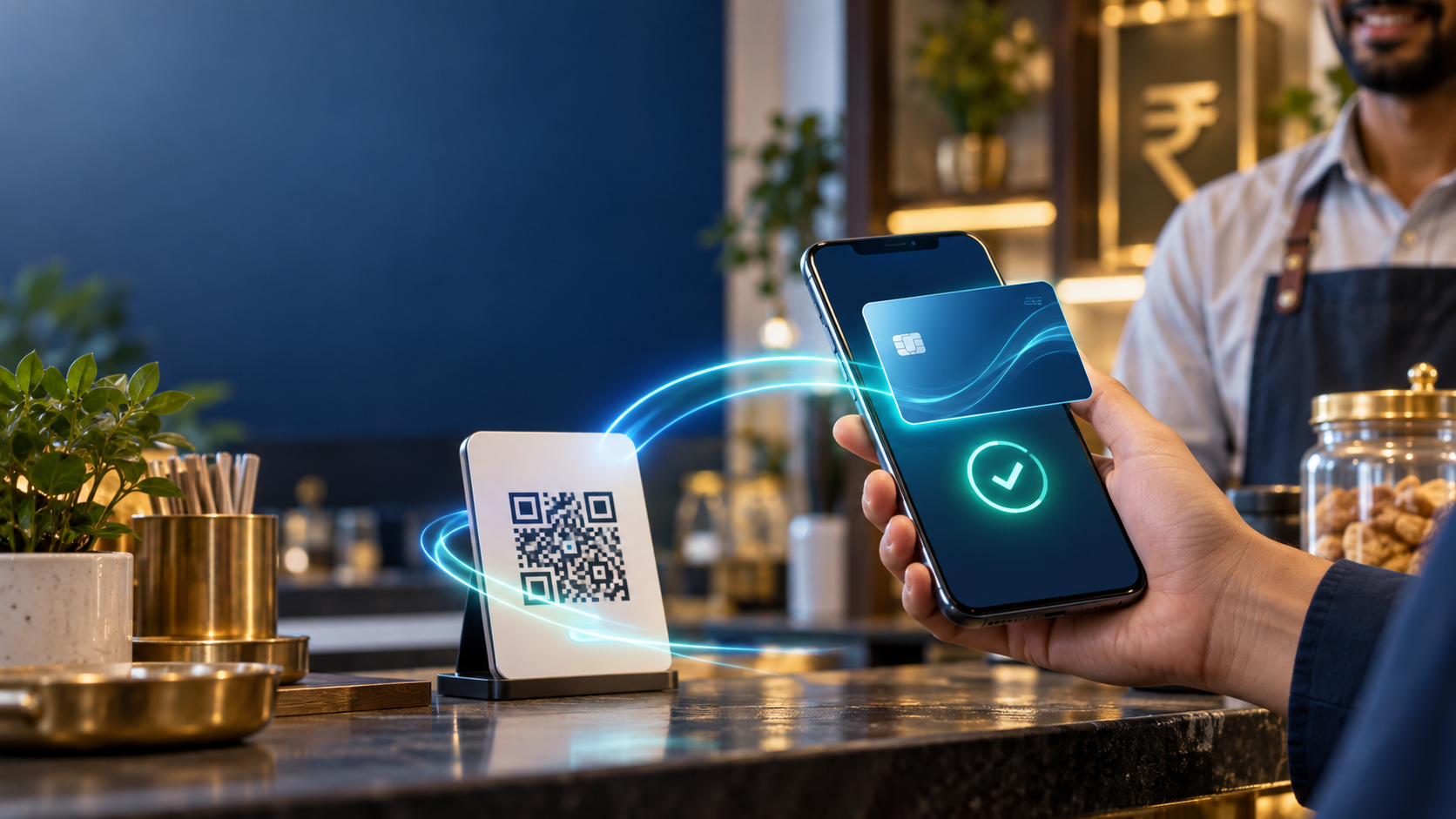
A practical guide to how RuPay credit cards work on UPI, what they cost, where they can be used and how to choose the right card.
What is a RuPay credit card on UPI?
A RuPay credit card can be linked to a supported UPI app and used for eligible merchant payments. It cannot normally fund person-to-person transfers, cash withdrawals or other restricted categories. The transaction is still credit-card borrowing, so pay the total amount due on time to avoid interest and late-payment charges.
RuPay credit card on UPI combines the acceptance reach of UPI merchant payments with a credit card as the funding source. After linking an eligible RuPay card to a supported UPI app, you can scan a merchant QR code, select the card and authorize the payment using the UPI PIN created for that card.
The purchase is charged to your credit-card account rather than deducted immediately from your savings account. It appears in your card statement and uses part of your available credit limit. If you pay the full statement balance by the due date, eligible purchases may receive the card’s interest-free period. If you carry a balance, normal card interest and charges can apply.
RuPay credit card on UPI is not the same as Credit Line on UPI. The former uses an issued RuPay credit card; the latter uses an eligible pre-sanctioned bank credit line. NPCI lists them as separate UPI products.
What changed for consumers?
- More merchant acceptance: A linked RuPay card can be used at many UPI-enabled merchants without a physical point-of-sale terminal.
- One payment experience: Users can choose a bank account or eligible RuPay card within the same UPI app.
- Potential rewards: Eligible merchant purchases may earn cashback or reward points, subject to the issuer’s exclusions, caps and minimum transaction rules.
- Easier expense tracking: Small merchant payments appear on the credit-card statement, which can simplify monthly review—but can also make overspending easier.
Where can you use a RuPay Credit Card on UPI?
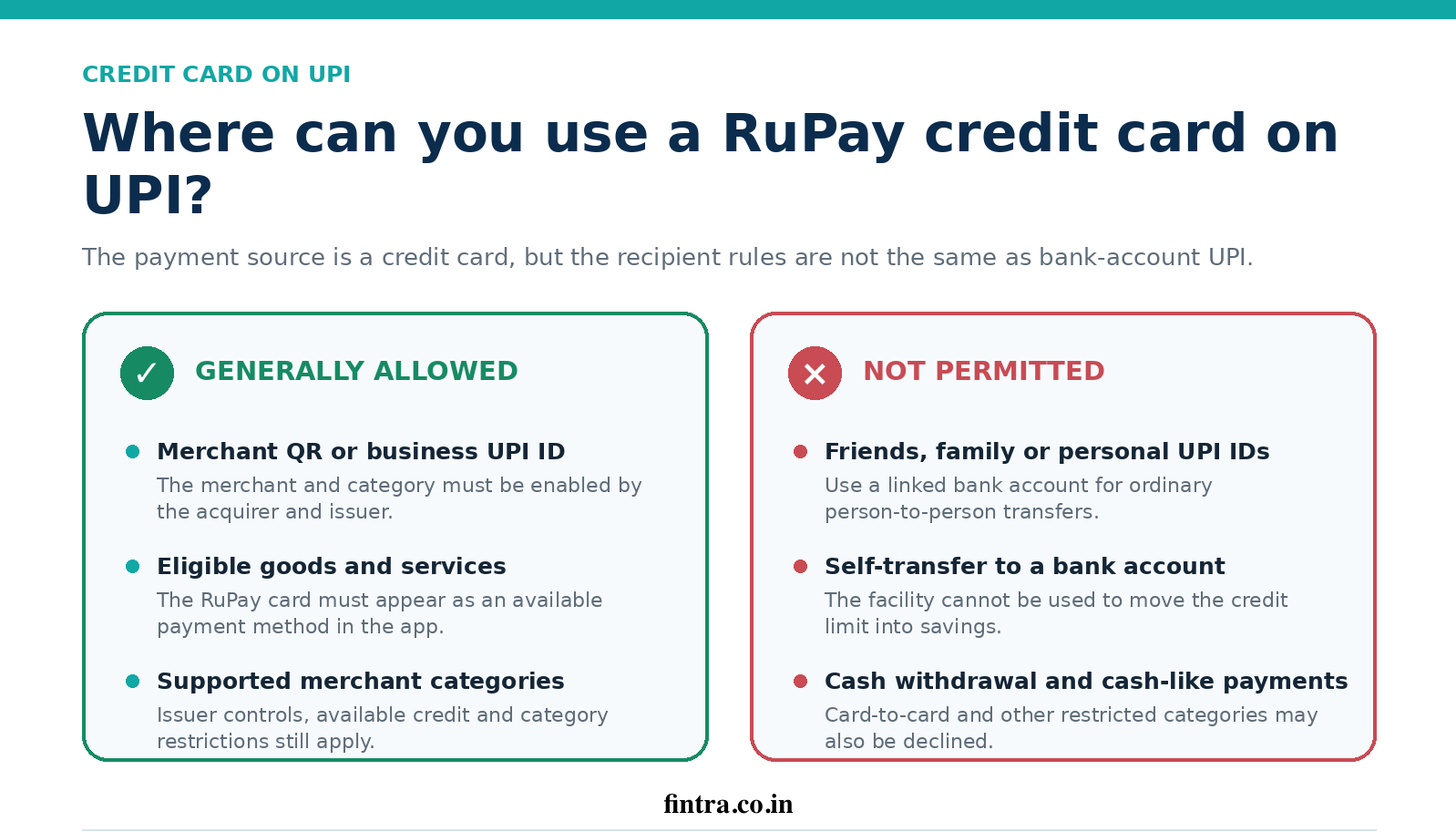
The most important distinction is between person-to-merchant (P2M) and person-to-person (P2P) payments. RuPay credit cards linked to UPI are designed primarily for eligible merchant payments.
|
Payment type |
RuPay credit card on UPI |
What it means |
|
Merchant QR or business UPI ID |
Generally allowed |
The merchant and its category must be enabled by the acquirer and issuer. |
|
Friends, family or personal UPI ID |
Not permitted |
Use a linked bank account for ordinary P2P transfers. |
|
Self-transfer to a savings account |
Not permitted |
The card cannot be used to move the credit limit into your bank account. |
|
Cash withdrawal or cash-like transaction |
Not permitted |
Use only channels and facilities expressly allowed by the issuer. |
|
Restricted merchant category |
May be declined |
NPCI and issuers restrict categories such as certain lending, account-opening and investment-related payments. |
|
Important: A QR code may look like a merchant QR but still be classified differently in the payment network. If the RuPay card is unavailable or the transaction is declined, select your bank account or another accepted payment method. |
How the payment works
- Linking: The UPI app fetches eligible RuPay cards associated with the mobile number registered with the issuer.
- UPI PIN setup: You create a dedicated UPI PIN for the linked card using the verification method supported by the bank and app.
- Merchant identification: When you scan or select a merchant, the app checks whether card-funded UPI payments are accepted for that merchant and category.
- Authorization: The issuer checks the available credit limit, issuer-set controls and fraud-risk rules. You approve the payment with the card’s UPI PIN.
- Confirmation and settlement: You and the merchant normally receive immediate confirmation. Merchant settlement follows the acquiring bank or payment provider’s settlement arrangement.
Your full card number is not displayed to the merchant. Avoid describing every RuPay-on-UPI scan as identical to card-on-file tokenisation, however, because implementation details can vary by app, issuer and network flow.
How to link a RuPay credit card to UPI
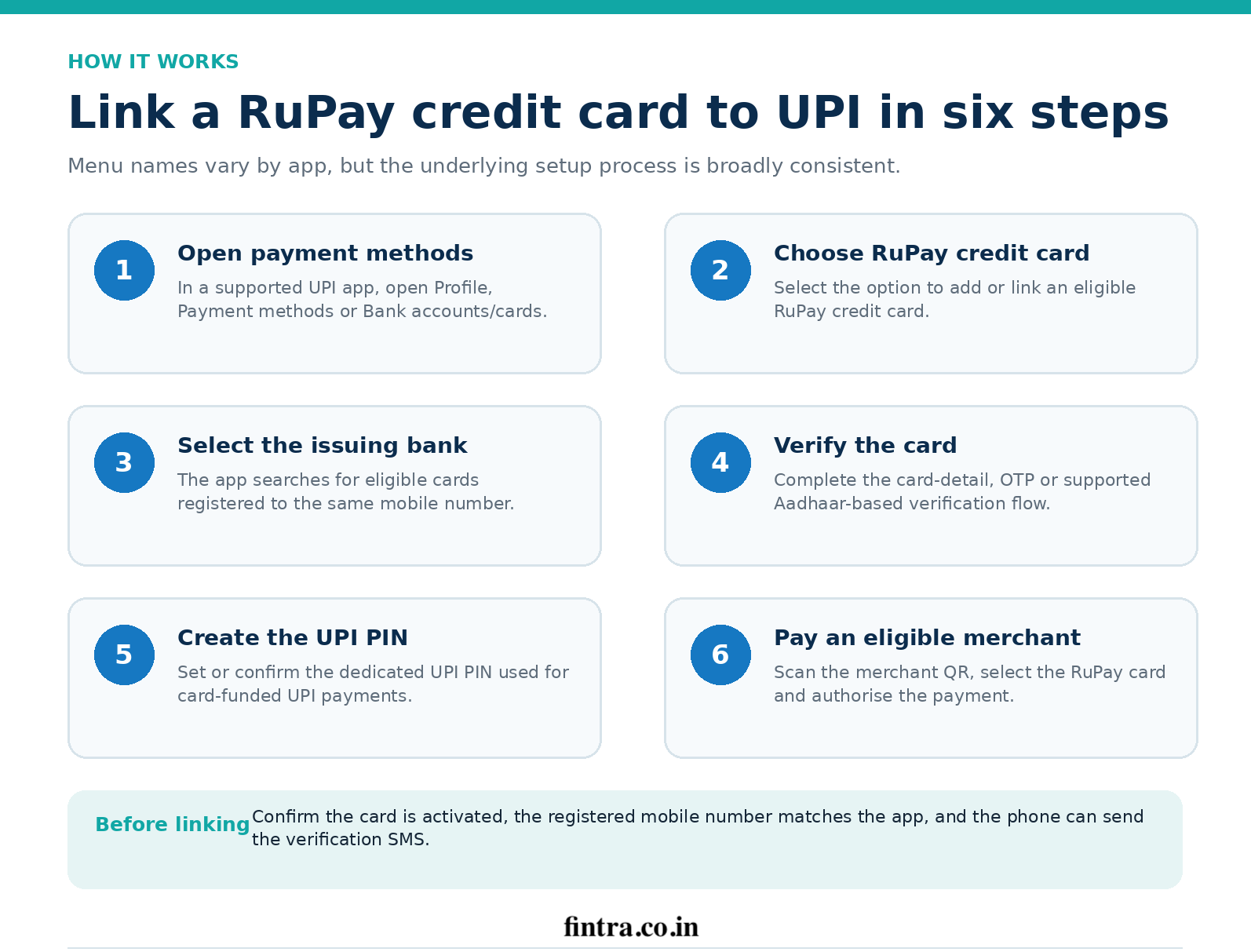
The exact menu labels change as apps are updated. The reliable process is:
- Open a supported UPI app and go to Profile, Payment methods or Bank accounts/cards.
- Choose the option to add or link a RuPay credit card.
- Select the issuing bank. The app will search for eligible cards registered to the same mobile number.
- Verify the card using the details, OTP or Aadhaar-based method supported by the issuer.
- Create or confirm the card-specific UPI PIN.
- During an eligible merchant payment, select the RuPay card before authorizing the transaction.
App-specific guidance
|
App |
Where to look |
|
Profile picture → Payment methods → Add RuPay credit card. Current Google Pay help confirms that RuPay cards are for supported merchant transactions. |
|
|
Profile → Payment methods or RuPay credit card section. Follow the current in-app prompts. |
|
|
UPI settings or Payment settings → Link/add RuPay credit card. |
|
|
BHIM |
Bank account/payment-method area → add an eligible credit card, if supported in the installed version. |
|
PayZapp |
Accounts/cards or UPI payment-method area. Availability and card discovery depend on the issuer and app version. |
Before troubleshooting, confirm that the card is activated, the issuer supports RuPay-on-UPI, the registered mobile number matches the app’s number and the phone can send the required verification SMS. Newly issued cards may take time to become available for UPI linking.
RuPay credit card UPI charges and MDR in 2026
For cardholders, there is generally no separate standard UPI transaction fee simply for selecting a RuPay credit card. However, “completely free in every situation” is too broad. A merchant, bill-payment service or app may display a convenience or platform charge for a particular service. Always check the final amount before entering the UPI PIN.
For merchants, Merchant Discount Rate (MDR) is the acceptance fee charged under the merchant’s acquiring arrangement.
In practical terms:
- The customer should normally see the full payable amount before authorisation.
- MDR is generally a merchant-side cost, but a merchant or platform may disclose a separate convenience charge to the customer.
- A merchant may disable credit-card acceptance on UPI or decline a category of card-funded UPI payments.
- Do not confuse RuPay-credit-card MDR with the separate zero-MDR policy applicable to ordinary bank-account-funded UPI transactions.
Transaction limits
There is no single limit that applies identically to every RuPay-credit-card UPI payment. The amount you can pay is the lowest applicable limit among:
- The available credit limit on your card.
- The issuer’s RuPay-on-UPI transaction and risk controls.
- Any lower limit you set in the issuer’s app.
- The UPI limit applicable to the transaction category.
- Merchant or acquiring-side acceptance rules.
UPI transaction ceilings vary by payment category and may be revised by the network or regulator. For a RuPay-credit-card payment, the amount available is never guaranteed by a headline UPI ceiling: the issuer, app, merchant category, available credit limit and card-level controls may impose a lower amount. Check the amount displayed in the app and the issuer’s current terms before a high-value payment.
Practical rule: Your usable amount is the lowest limit imposed by the network, issuer, app, merchant category and available credit line. Because these controls can change, this guide does not publish fixed category ceilings.
Best RuPay credit cards for UPI in 2026
The best card depends on where you spend, the value of its rewards after redemption, caps, excluded categories and whether any annual fee can be recovered. The figures below were checked on 18 September 2026. Fees, rewards, exclusions and eligibility conditions can change, so verify the latest terms on the issuer’s website before applying.
|
Card |
Joining / annual fee |
UPI reward headline |
Important condition |
Best suited to |
|
Rs. 0 / Rs. 0 on eligible Kiwi cards |
1.5% cashback on eligible Scan & Pay; up to 5% with Kiwi Neon |
Cashback caps, exclusions and paid Neon membership terms apply |
UPI-first users seeking straightforward cashback |
|
|
Rs. 0 (Check current offer) / Rs. 0 |
2 reward points per Rs. 100 on eligible UPI spends |
Fuel earns no reward points; selected categories earn differently |
Lifetime-free cardholders who value points and fuel-surcharge waiver |
|
|
Rs. 99 + tax / Rs. 99 + tax |
CashPoints on eligible UPI purchases; category rates vary |
Renewal-fee waiver after Rs. 25,000 annual spend; reward value and caps matter |
Frequent grocery, dining, utility and retail users |
|
|
Rs. 1,499 + tax / Rs. 1,499 + tax |
Up to 1.5% as NeuCoins on eligible UPI spends |
Full rate requires eligible payment through Tata Neu UPI ID; fee waiver at Rs. 3 lakh annual spend |
Regular Tata, BigBasket, 1mg and Croma users |
|
|
Rs. 0 / Rs. 0 |
3 reward points per Rs. 100 on eligible spends |
Virtual card; check current exclusions and redemption value |
Beginners wanting a lifetime-free virtual card |
|
|
Check current offer |
2 YES Rewardz Points per Rs. 200 on eligible non-UPI spends |
No UPI reward rate is listed; virtual-only card and exclusions apply |
Users wanting a lifetime-free virtual RuPay card, not UPI rewards |
|
|
Rs. 0 / Rs. 0 under current terms |
Programme rewards subject to Magnet terms |
Secured against minimum Rs. 5,000 FD; limit generally 90% of FD; ensure RuPay variant |
New-to-credit users or those rebuilding credit |
How to compare the rewards correctly
- Check whether UPI spends earn the same rate as card swipes or online transactions.
- Read exclusions for fuel, rent, wallets, education, government payments, insurance and utilities.
- Check the redemption value of reward points; a headline point count is not the same as a cashback percentage.
- Check monthly caps, minimum transaction values and redemption fees.
- Compare the annual fee with the reward value you can realistically earn.
Smart and responsible use
UPI removes much of the friction associated with paying by card. That convenience can make a series of small transactions feel insignificant even when the monthly total becomes substantial.
Use these safeguards
- Pay the total amount due—not merely the minimum due—by the payment deadline.
- Set a personal monthly spending budget that is lower than the card limit.
- Review cumulative UPI-card spending weekly instead of waiting for the statement.
- Keep credit utilisation modest and comfortably within your available limit. Credit-scoring models do not use one guaranteed utilisation threshold.
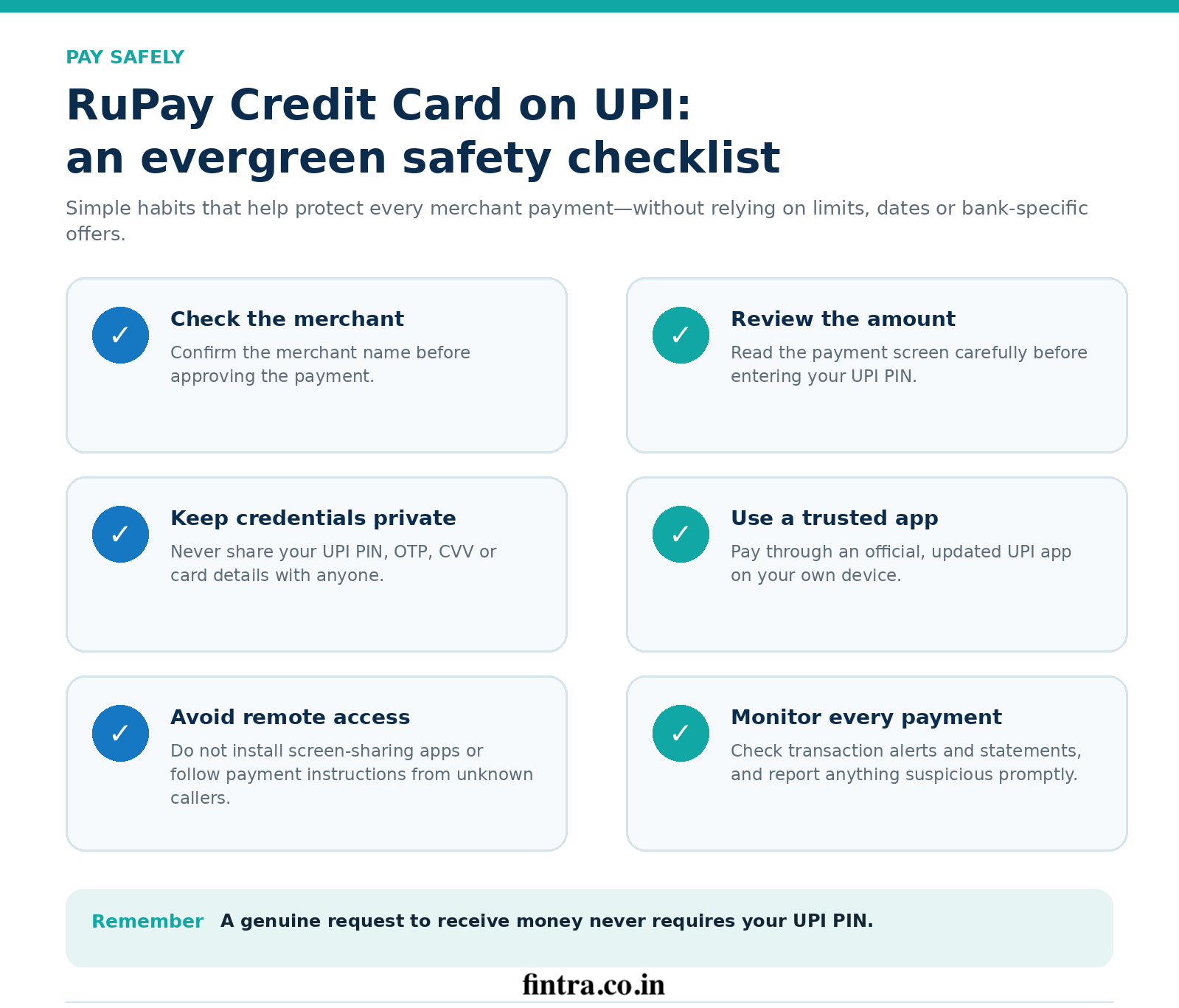
- Never approve an unknown collect request or share a UPI PIN, OTP, screen or remote-access control with anyone.
- Verify the payee name and final amount before entering the PIN.
- If the phone or SIM is lost, contact the issuer and mobile operator promptly, block or suspend the card and secure the UPI apps.
- Report suspected financial cyber fraud immediately through the bank and India’s cybercrime helpline 1930 or cybercrime.gov.in.
|
Financial caution: Keeping money invested while using a credit card for daily spending is not risk-free “liquidity optimisation.” Investments can fall in value, and credit-card interest can be extremely costly. This approach is sensible only when spending is budgeted and the full statement balance can be paid on time. |
Frequently asked questions about RuPay credit card on UPI
Can I send money to a friend using a RuPay credit card on UPI?
No. Ordinary person-to-person transfers are not permitted from a linked RuPay credit card. Select a linked bank account instead.
Can a merchant refuse RuPay credit-card UPI payments?
Yes. Acceptance depends on the merchant, acquirer, merchant category and issuer controls. The card option may be unavailable even when bank-account UPI works.
Are RuPay credit-card UPI payments free for customers?
There is generally no separate standard UPI transaction fee for the cardholder, but a merchant, app or bill-payment service may display a disclosed convenience or platform fee. Check the final payable amount.
Do all UPI purchases earn card rewards?
No. Rewards are subject to the card’s eligible categories, exclusions, caps, minimum transaction rules and redemption value.
Can Visa or Mastercard credit cards be linked to UPI in the same way?
The widely available card-linking facility described in this guide is built around eligible RuPay credit cards. Other credit products may appear through separate issuer or credit-line arrangements.
Does using a RuPay credit card on UPI affect my credit score?
It forms part of normal credit-card usage. Payment history, reported balances, utilisation and other credit-profile factors can affect the score. Paying in full and on time is more important than merely using the card.
What should I do if the transaction is pending or fails?
Do not immediately pay again unless the first transaction is clearly shown as failed. Check the app and card account, save the reference number and follow the issuer/app dispute process if the amount is not reversed within the applicable timeline.
Conclusion
RuPay credit card on UPI is useful when it turns eligible everyday merchant payments into trackable, potentially rewarding card transactions. Its value depends less on the novelty of scanning a QR code and more on disciplined repayment, realistic reward calculations and choosing a card that matches your actual spending.
Before applying, verify the latest issuer terms, annual fee, reward exclusions, redemption value and UPI eligibility. After linking, treat every scan as borrowed money—not as an extension of your bank balance.
Ready to compare your options?
Explore Fintra’s credit-card guides, eligibility information and card comparisons. Compare the total value of a card—not just its headline reward rate—before applying.


